
Warren County Projected Versus Actual
A projected release date is a sentence calculation. It can reflect the term imposed, prior custody credit, credits earned or lost, statutory restrictions, parole status, and current administrative data. An actual release date records the completed physical exit. These dates may match, but they serve different purposes.
A pretrial detainee usually has no fixed sentence release date. The next event may depend on bond, recognizance, dismissal, plea, trial, or another court order. For that person, a court docket and WCRJ custody status are more useful than KOOL's projected-date filter. A sentenced state prisoner is different because DOC maintains a sentence calculation.
- Projected release
- A current estimate based on sentence and credit data.
- Maximum expiration
- The endpoint shown for the controlling sentence calculation, subject to the official record.
- Parole eligibility
- A point when Board review may occur, not a promised release.
- Time served
- Release based on completion or credit of the custodial term ordered.
Find Warren County Projected Dates
Identify who owns the sentence before choosing a portal. Kentucky Online Offender Lookup is the right starting point for a DOC-linked prisoner. Its advanced form labels the date filter “Projected Release Date From / To.” Individual records may also display projected or proposed release and maximum-expiration information. KOOL does not cover every local misdemeanor or short jail sentence.
- Search KOOL by name, alias, DOC number, or PID. Compare the location and identifying details.
- Open the matching record and read the projected release, proposed release, maximum expiration, parole, and supervision fields that are present.
- Determine whether the person is a DOC-linked state prisoner or a purely local Warren County prisoner.
- For a local sentence, request the judgment, custody-credit order, amendments, and release calculation from the Warren clerk and WCRJ.
- For a pretrial case, follow bond and court events instead of assigning a sentence date that does not exist.
- Before travel, confirm the actual event through the custodian or a VINE Inmate Check.
KOOL says records are updated daily, does not guarantee accuracy, and warns that data newer than 120 days may not be finalized. The Warren County released-inmate search supplies the broader court and release-record path.
Warren County Sentence Credit Rules
KRS 197.045 authorizes several distinct forms of credit. It includes authorized credit for custody before sentence, a 90-day credit for qualifying educational achievements, up to 90 days for approved treatment or life-skills programs, discretionary good-behavior credit up to ten days for each month served, and qualifying exceptionally meritorious or emergency-service credit.
These categories are not automatic substitutes for reading the sentence sheet. Credits other than prior confinement can be denied or forfeited for certain offenses or institutional-rule violations. Consecutive sentences are aggregated for credit calculations. Sex-offender treatment provisions can also restrict when credits apply, with statutory exceptions. The current law, offense, and individual sentence control.
For state prisoners in a county jail, 501 KAR 2:060 applies statutory, meritorious, educational, and approved-program credit rules to qualified people. This makes the person's legal custody class more important than the building name.
Note: Good time can change a projection, but no reader should recalculate an official Warren County date from a general rule alone.
Warren County's Limited 85% Rule
KRS 439.3401 defines covered violent offenders and imposes minimum-service restrictions. For covered term-of-years cases, the law generally restricts probation, shock probation, parole, conditional discharge, or another early release until at least 85 percent is served. Covered life, capital, and Class A life cases follow a different statutory minimum framework.
The statement “Kentucky inmates serve 85 percent” is wrong. Coverage depends on the offense, statutory classification, offense date, sentence type, and exceptions. Nonviolent cases and other sentence-credit paths work differently. A docket label or charge alone should not be used to compute the date. Use the final judgment and DOC calculation.
Parole eligibility also is not sentence expiration. The Kentucky Parole Board can review an eligible person, defer action, deny parole, or recommend release. A recommendation or proposed date still needs a later custody confirmation.
Why Warren County Dates Change
A projection can move in either direction. Some causes arise from the sentence-credit calculation. Others come from a new court or agency event. The effect cannot be known from a current jail roster alone.
| Factor | Possible effect | Record to check |
|---|---|---|
| Prior custody credit corrected | Projection may move earlier or later | Judgment, credit order, sentence sheet |
| Approved program or education credit | May reduce time under current law | DOC calculation |
| Disciplinary forfeiture | May move the date later | DOC sentence and institutional record |
| New warrant or detainer | Can block community exit or cause transfer | Court and receiving agency |
| Parole action | Can create, defer, or deny a release path | Written Board action and KOOL |
| Amended court order | Can alter sentence or custody credit | Warren court docket and order |
| Home incarceration | Can move the person out of the jail under monitoring | Court order and WCRJ program record |
A detainer is another authority's request to hold or notify before release. It can turn a planned community exit into a transfer. Ask for the release disposition or destination whenever another agency may be involved.
Warren County Jail State Calculations
WCRJ houses more than ordinary local pretrial detainees. A person in the county building may be a Class C or D state prisoner with a DOC-linked calculation. Kentucky's county-jail credit regulation and the DOC Daily Releases archive both support this distinction. The archive includes some people released from Warren County Jail.
Therefore, “county jail” does not always mean “county-only sentence.” Determine whether the record is tied to Kentucky DOC before using or rejecting KOOL. A DOC number, state conviction, controlled-intake status, or KOOL record can point toward the state path. For a purely local misdemeanor sentence, begin instead with the judgment, custody-credit order, and WCRJ calculation.
The DOC Daily Releases archive is date based. It can corroborate an actual state-linked release and identify the releasing location, but it omits ordinary local bond releases. Its PDFs also do not provide photographs.
Warren County Home Incarceration
WCRJ's Home Incarceration page describes a concrete local status. Placement requires a court order. Onboarding occurs through Door 101 and the Class D office during stated weekday intake hours. The page also identifies a working telephone, a drug test, a GPS ankle unit, and participant costs.
A person in home incarceration can be physically out of the Warren County jail while still serving a court-ordered monitored status. That is not final discharge. Check the court order and program status rather than treating roster disappearance as unconditional release.
View the WCRJ home-incarceration source shown below.
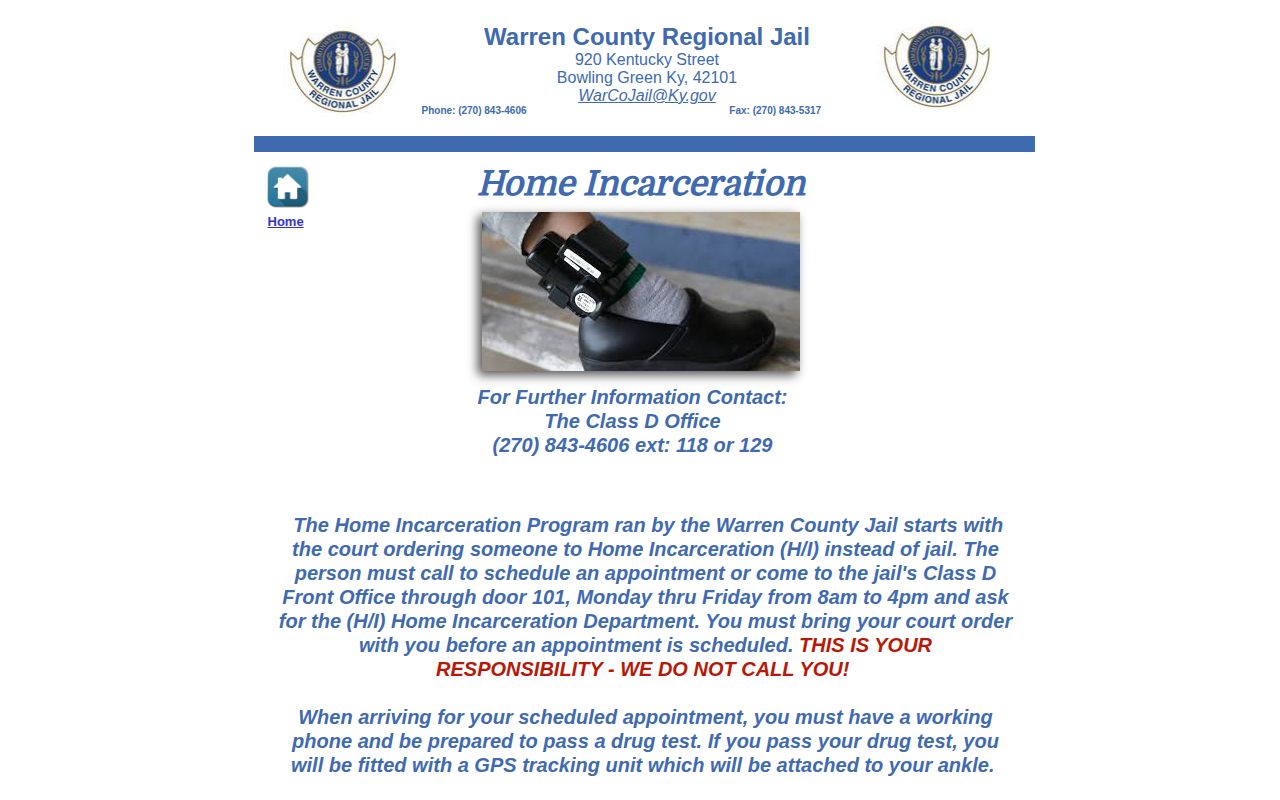
The official program page illustrates why location and legal status must be read together when checking a Warren County release date.
Confirm Warren County Actual Release
For WCRJ, call 270-843-4606 or request the booking and release record. Ask for the exact release date and time, disposition, releasing authority, and destination if transferred. For a state sentence, use KOOL and Kentucky DOC records. For the order behind a local sentence, contact the Warren Circuit Court Clerk at 270-746-7400.
VINE can send a pending release or transfer notice, but the alert remains a lead. Compare it with the custodian's dated record. If the date changes, obtain the newest calculation instead of relying on an older screenshot or saved search result.
Mandatory reentry supervision creates another important distinction. An eligible person may leave the institution before projected sentence completion under KRS 439.3406 and remain supervised until the statutory endpoint. That person is released from the institution but not fully discharged.
A precise records request should name the calculation that is needed. For WCRJ, ask for the jail sentence calculation and release disposition tied to the booking. For Kentucky DOC, identify the person by full name, date of birth, or offender number and ask for the sentence-calculation sheet, release authorization, exact release type, and discharge document when applicable.
The Warren clerk should be asked for the judgment, custody-credit order, amended judgment, probation order, or revocation order by case number. “Case disposed” does not state when the jail completed release processing. The court order and custodian's exit record answer different parts of the question, so keep both dates in the final verification.
Keep the source and access date with each projected figure. Warren research found no official fixed release-processing schedule, weekend rule, exit door, or family waiting area. Do not turn office hours into a promised exit time. Call the custodian before travel and ask whether the date is an estimate, an authorized release, or a completed physical exit.